
Brainsight Breakthroughs: Astrocytes connect specific brain regions through plastic networks
June 17, 2026
11:00 AM EST / 08:00 AM PST
WE ARE LIVE IN
About the webinar
Neuronal axons have traditionally been considered to be the primary mediators of functional connectivity among brain regions. Astrocytes communicate with one another through gap junctions, but the extent and specificity of this communication remain poorly understood. We developed a vector-based approach that labels molecules as they are fluxed by astrocyte gap junctions in awake, behaving animals, and then used whole-brain tissue clearing to image intact, three-dimensional astrocyte networks. We show that multiple astrocyte networks traverse the mouse brain. These networks selectively connect specific regions, rather than diffusing indiscriminately, and vary in size and organization. We observe local networks that are confined to single brain regions and long-range networks that robustly interconnect multiple regions across hemispheres, often exhibiting patterns distinct from known neuronal networks. We also demonstrate that astrocyte networks undergo structural reorganization in the adult brain after sensory deprivation. These findings reveal a mode of communication between distant brain regions that is mediated by plastic networks of gap junction-coupled astrocytes.
Dr Melissa Cooper obtained her PhD in Neuroscience with Dr David Calkins at Vanderbilt University. Her work revealed that networks of astrocytes redistribute metabolic resources across the central nervous system to combat local neurodegeneration. While this protects regions that otherwise would degenerate, donor regions become vulnerable to future neurodegeneration. Her work also uncovered a unique property of astrocyte networks - they directly connect different CNS regions than those linked by neurons. This means that our understanding of neuronal networks cannot predict the structure of astrocyte networks. As a postdoctoral fellow, Melissa has expanded upon her previous work, developing a new tool that reveals functional, in vivo astrocyte networks. Through tissue clearing, Melissa maps these networks across whole, intact brains. Combining types of microscopy ranging from single-molecule super-resolution through whole-brain light-sheet, Melissa has characterized astrocyte networks in disease models and in homeostatic function.
Explore past breakthroughs
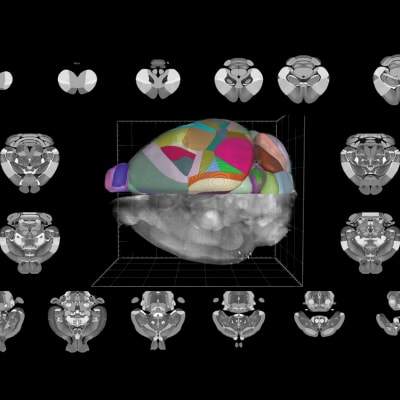
Neural activity after brain injury
Cleared brain imaging and 3D atlas registration uncover key neural signatures of trauma.
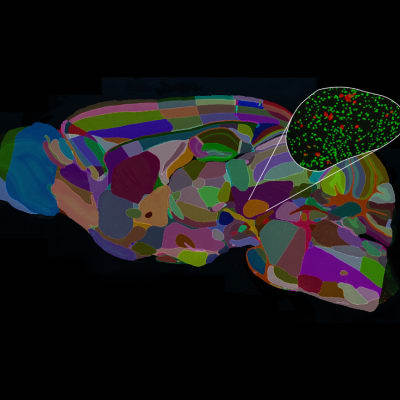
Motor deficits predict tau pathology
Automated slide scanning, 2D atlas registration, and tau detection link behavior with pathology.
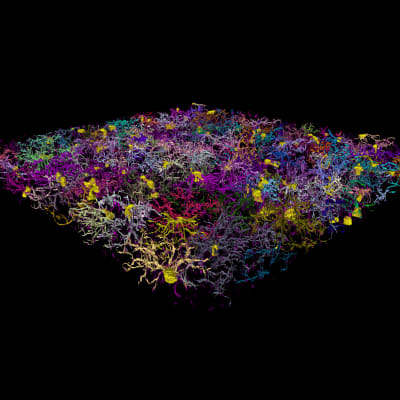
Glial morphology in addiction
Airyscan imaging, AI segmentation, and 3D tracing reveal microglial morphology changes.
DOWNLOAD OUR EVENT APP