
Stroke Tank: Pitch It to the Judges! Proposals

Enhanced Medical Control in the Prehospital Triage of Patients with a Suspected Severe Stroke
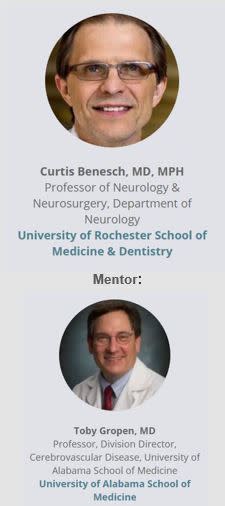
Curtis Benesch, MD, MPH - Professor of Neurology and Neurosurgery, Department of Neurology, University of Rochester School of Medicine & Dentistry
Jeremy Cushman, MD, University of Rochester School of Medicine & Dentistry, Department of Emergency Medicine
Bryan Gargano, MD, Rochester Regional Health, Department of Emergency Medicine, Rochester, NY
Optimal strategies for the identification and triage of patients with a potential large vessel occlusion (LVO) in the prehospital setting are lacking due to limited applicability of prehospital stroke severity scales, regional variability in advanced stroke care capabilities, and geographic factors. Whereas recent guidelines from the American Stroke Association provide recommendations for the use of mechanical thrombectomy in patients with LVO and support the need for stroke systems of care to provide those services, specific considerations for the prehospital identification and triage of those patients are lacking.
Recent evidence has suggested that a simple modification of the face-arm-speech score (FAST; also known by the Cincinnati Prehospital Stroke Scale [CPSS]) by adding the determination of a gaze preference, may help in stratifying patients with a suspected LVO for triage to a center with advanced stroke capabilities. We hypothesize that including gaze preference with the existing FAST (G-FAST or CPSS plus gaze based in destination Emergency Room) , with the goal of optimizing triage of patients with a potential LVO to an endovascular-capable/comprehensive stroke center. This study will examine the feasibility of utilizing an Enhanced Medical Control (EMC) algorithm in the Rochester region, and will provide preliminary estimates of the accuracy of this algorithm in the evaluation of patients presenting to EMS with an acute stroke due to LVO.
Slides: Benesch_StrokeTank.pdf
Tele-Stroke Prehospital Assessment and Routing
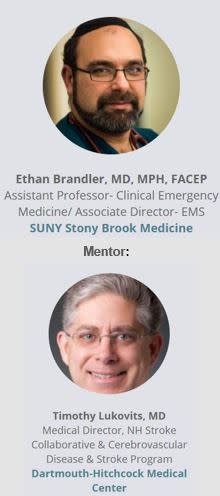
Ethan Brandler, MD, MPH, Assistant Professor, Department of Emergency Medicine, Stony Brook Medicine
David Fiorella, MD, PhD, Stony Brook Medicine, Department of Neurological Surgery and Radiology, Stony Brook, NY
Tele-Stroke assessments by neurologists are now in widespread use across the country guiding emergency treatment of stroke. The utility of a smartphone and iPad to transmit remotely performed NIHSS has been demonstrated previously, but there have been no exam-based changes in routing made. We plan to demonstrate the feasibility of EMTs transmitting recorded or live exams to remote EMS physicians in order to allow a determination of the likelihood of the presence of a large stroke routing to patient appropriate endovascular capable centers.
EMTs will examine suspected stroke patients on camera and transmit videos via a secure CarePoint system. Videos will be routed to EMS physicians who will make a severity assessment and recommend a destination based on clinical factors and transport time factors. The physician will have the opportunity to request additional information and/or perform additional clinical assessments. The physician will then recommend a destination based on the perceived need for IV tPA, endovascular therapy and treatments for other potential confounding diagnoses.
As with all medical control contacts, we will conduct follow up to determine if stroke was diagnosed in the hospital, if patients received tPA and if they were transferred for further endovascular intervention. The majority of transfers will be transferred to our facility. We also will determine paramedic satisfaction regarding the on-line clinical exam and disposition decision process.
The primary outcome is feasibility of the telestroke process in making a hospital destination decision. Secondary outcomes include provider satisfaction and inter-rater reliability between the physician, EMT and neurologist.
Slides: Brandler_StrokeTank.pdf
Diversion of Suspected Stroke Victims Through EMS Intervention (DRIVE)

Brian Silver, MD, Professor and Vice Chair, Department of Neurology, UMass Memorial Medical Center
Bruce Barton, PhD, Director, Quantitative Methods Core, Professor, Division of Biostatistics, Department of Quantitative Health Sciences, University of Massachusetts Medical School, Worcester, MA
Dora M. Dumont, PhD, MPH, Senior Public Health Epidemiologist, Division of Community Health and Equity, Rhode Island Department of Health, Providence, RI
Prompt delivery of thrombolytic therapy in patients with acute ischemic stroke and embolectomy in those with large vessel occlusion leads to better outcomes. Reorganization of acute stroke services may lead to improvement in stroke care delivery. In 2015, the RISTF approved a proposal to have all patients with large vessel occlusion diverted to a center that can deliver embolectomy for large vessel occlusion if the drive time was within 30 minutes. The protocol was implemented January 1, 2016. Rhode Island stroke data, available from the Department of Health from January 1, 2015 to June 30, 2018 will be used. The same data, during the same time line, from central Massachusetts, which does not have a diversion protocol, will also be collected from a central repository. There are approximately 2,500 patients from each region per year (total 17,500) for this analysis. The primary outcome measure will be discharge destination dichotomized as good (home, home with services, acute rehabilitation) or poor (skilled nursing facility, death, home with hospice, hospice), adjusted for age, sex/gender, race, and initial NIHSS. Comparison of regional outcomes i.e. Rhode Island, after change to diversion, will be compared with central Massachusetts (no diversion in place), through a multivariable logistic regression analysis. To account for regional specific characteristics that may not be captured in crossstate comparisons, interrupted time series analyses will be used to analyze the impact of diversion on the outcomes of interest before and after its implementation in Rhode Island.
Pre-Hospital Triage Decisions for Patients with Suspected Stroke Due to Severe Large Vessel Occlusion Stroke

Kori Sauser Zachrison, MD, MSc, Assistant Professor, Department of Emergency Medicine, Massachusetts General Hospital
Patrick Eschenfeldt, PhD, MGH Institute for Technology Assessment
Ayman Ali, BS, MGH Institute for Technology Assessment
Chin Hur, MD, MPH, MGH Department of Medicine and MGH Institute for Technology Assessment, Boston, MA
A Decision Analytic Modeling Cost-Effectiveness Study
Tissue plasminogen activator (tPA) and endovascular thrombectomy (EVT) are time-dependent interventions that reduce long-term disability for patients with acute ischemic stroke. tPA may be rapidly administered at a primary stroke center (PSC), however EVT is performed at comprehensive and thrombectomy-capable stroke centers (CSCs). Currently, we lack evidence to guide the optimal pre-hospital triage of patients with suspected large vessel occlusion (LVO) to PSCs versus CSCs depending on transport times, local resources and timelines of care. Our primary aim is to develop, analyze, and verify a decision model that includes repeated triage simulations of a patient with suspected stroke due to LVO to determine the effectiveness and costeffectiveness of various pre-hospital triage approaches. The model will include three scenarios: 1) patient is transported to the nearest PSC, receives tPA without delay, and is rapidly transported to the nearest CSC for EVT; 2) patient is transported directly to the nearest CSC for EVT, bypassing a PSC, and receives tPA at the CSC after a potential delay due to longer EMS transport time; and 3) patient is transported directly to the nearest CSC, bypassing a PSC, but is ultimately ineligible for EVT and receives tPA at the CSC after a potential delay due to longer EMS transport time. This decision model will determine the ideal transport destination for patients with suspected stroke due to LVO based on patient presentation, transport times and variation in DTN times. These results will help inform pre-hospital triage decisions and next steps in improving stroke systems of care.
Slides: Ali_Eschenfeldt_StrokeTank.pdf
Predicting Cerebral Large Vessel Occlusion Through Non-Invasive Oximetry
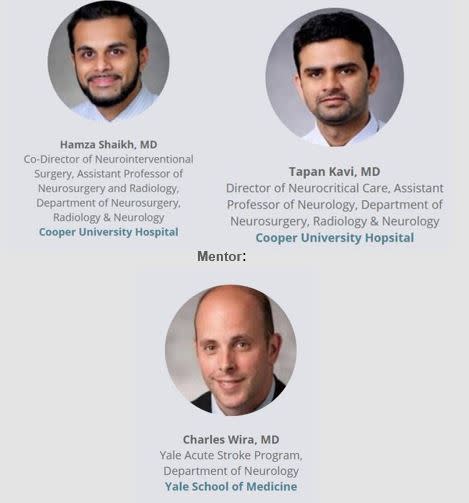
Hamza Shaikh, MD, Co-Director of Neurointerventional Surgery, Assistant Professor of Neurosurgery and Radiology, Department of Neurosurgery, Radiology, and Neurology, Cooper University Hospital
Tapan Kavi, MD, Director of Neurocritical Care, Assistant Professor of Neurology, Department of Neurosurgery, Radiology, and Neurology, Cooper University Hospital, Camden, NJ
Delay in transferring stroke patients with Large Vessel Occlusion (LVO) to a center with interventional capacity can have devastating impact on outcomes. We are looking to improve Emergency Medical Services (EMS) recognition of LVO by using non-invasive cerebral oximetry (NCO). Although best studied in cardiac surgery cases,1,2 non-invasive cerebral oximetry has also been evaluated during endovascular therapy of stroke and carotid endarterectomy.3,4 Rapid Arterial Occlusion Evaluation (RACE) score has been recently developed to identify patients with LVO, however the accuracy of these assessment scales is less than desirable.5 We are trying to establish if cerebral perfusion assessed through non-invasive cerebral oximetry along with clinical scales can improve the accuracy in predicting LVO. This observational study will involve using non-invasive cerebral oximetry on patients suspected by EMS to have LVO based on RACE > 4. These patients will then be followed up to reveal presence or absence of LVO. The values for cerebral oximetry will then be evaluated to have the best predictability (sensitivity and specificity) for LVO.
Slides: Shaikh_Kavi_StrokeTank.pdf