
- Risk to populated areas and critical infrastructure considered very low
- No disruptions to international aviation
- Volcanic activity follows considerable seismic activity over the past few days
- The fissure is close to the site of an eruption of a similar type last year
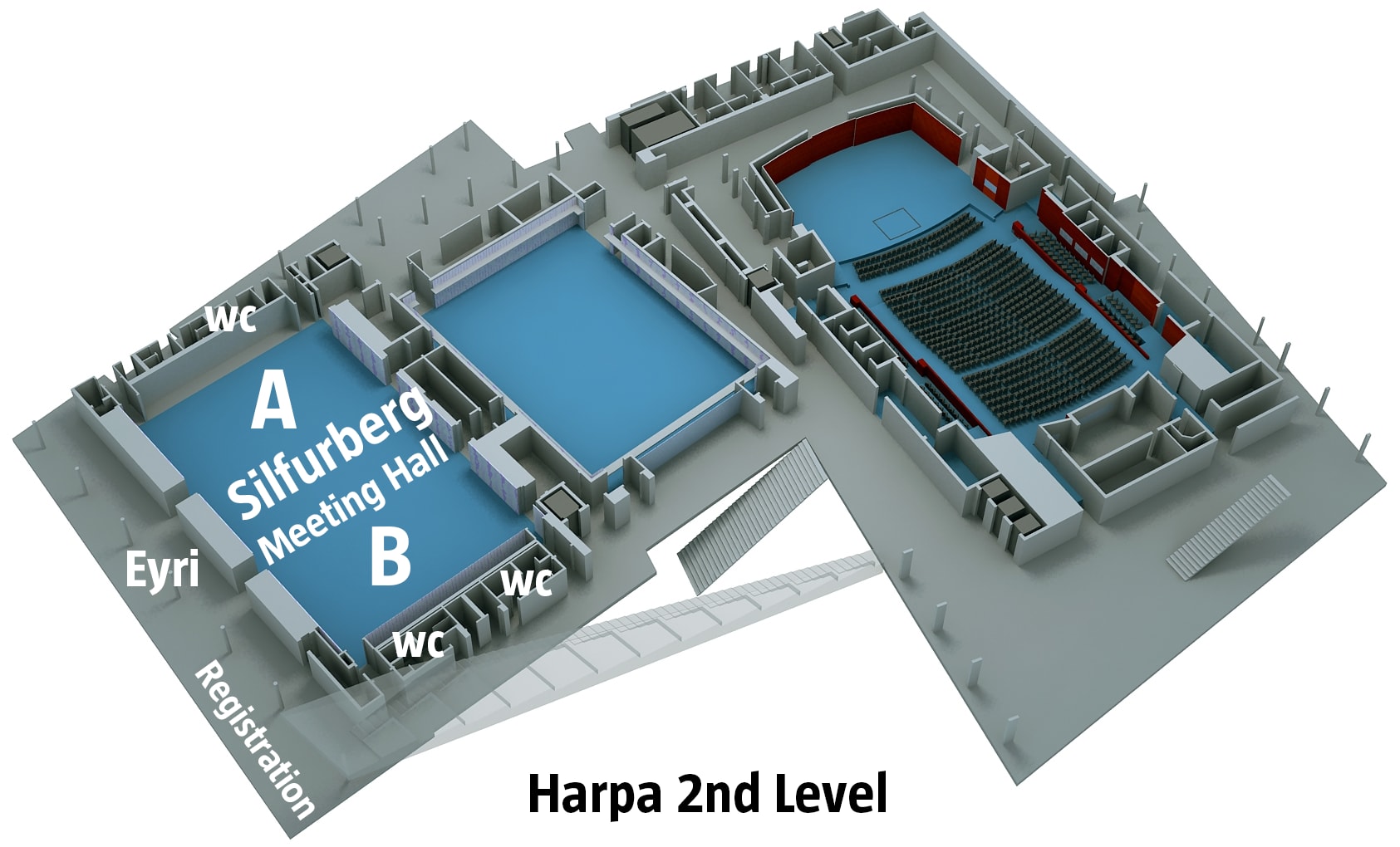
HARPA FLOORPLAN

VOLCANIC ERUPTION
A small volcanic eruption on the Reykjanes peninsula in southwest Iceland
At 13:18 GMT on 3 August lava began flowing from a ground fissure around Fagradalsfjall near the town of Grindavík on the Reykjanes peninsula. The eruption started in the wake of intense seismic activity lasting several days.
The site of the eruption is close to last year’s eruption that lasted for about six months. According to the Icelandic Met Office, the exact location of the fissure is in Meradalir about 1.5 km north of Mt. Stóri-Hrútur. The area is in southwest Iceland, about 15 km from Keflavik International Airport and about 25 km from the Reykjavík metropolitan area.
The eruption is considered to be relatively small and due to its location, there is low threat to populated areas or critical infrastructure. However, it is possible that pollution can be detected due to the gas release, so people are advised against visiting the site.
Currently, there have been no disruptions to flights to and from Iceland and international flight corridors remain open.
The response to the ongoing volcanic activity is led by the Department of Civil Protection and Emergency Management of the police in cooperation with the Icelandic Meteorological Office and the University of Iceland.
The eruption is classified as a fissure eruption (often referred to as Icelandic-type) and does not usually result in large explosions or significant production of ash dispersed into the stratosphere.
COVID-19
At present no Covid-related restrictions are in place in Iceland. The number of cases in Iceland has been declining in July and early August and throughout the summer the infection rate has been much lower than during the height of the epidemic in Iceland, in February and March this year.
We urge participants to be fully vaccinated with booster, as well as obtaining a PCR-test or carry out your own rapid test, before travelling to Iceland and take all necessary precautions during travel. All infection prevention rules for COVID-19 have been lifted at the Icelandic border, regardless of tourists’ vaccination status. However, it varies what rules apply at the borders of other countries. In the Harpa conference centre, face masks and sanitizers will be provided, but we will not impose regulations stricter than those that are currently in effect in Iceland and in several neighbouring countries. We will not be strictly enforcing these recommendations but operate an honour-based system.
Upon receiving their name badges, participants will be offered the choice to label their badge with a colour-code:
Red coloured dot: High Sensitivity, please keep your distance!
Orange coloured dot: Ok with < 2 m distance but no physical contact.
Green coloured dot: Handshakes and hugs are OK.
Note that this labelling will be voluntary and you are not obliged to place a coloured dot on your badge.
If a participant falls ill during the symposium or notices symptoms that might be resulting from a Covid-infection, please visit immediately one of the locations in Reykjavík where Covid-tests are offered or take your own personal rapid test. Should you test positive, we expect that you will take the appropriate measures (please read), which include self-isolation for five days, and not attend any subsequent Symposium events.
LINKS:
Statistical information on Covid-19 in Iceland: https://covid.is
Information on PCR Covid testing: https://www.heilsugaeslan.is/um-hh/covid-19/?lang=en-us